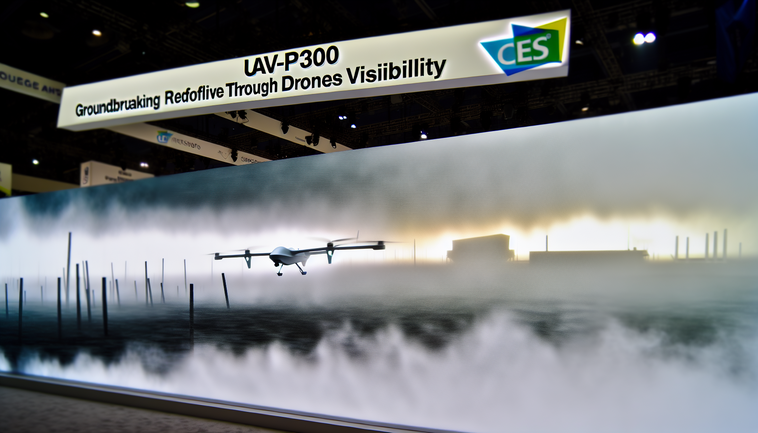
GDU has once again pushed the envelope in aerial technology by unveiling its latest creation, the UAV-P300. Unveiled at CES 2026, this drone promises to break through weather obstacles that have long challenged operators. By marrying advanced imaging hardware with cutting-edge AI algorithms, GDU aims to deliver a platform that performs reliably even when the skies turn murky.
At the heart of the UAV-P300 lies a proprietary system combining enhanced optical sensors and electronic signal processing. Instead of simply amplifying camera feeds, this drone employs machine learning models that adapt on the fly, filtering out background noise and revealing details hidden in fog or rain. Early test flights reportedly demonstrate a dramatic improvement in scene clarity, giving teams a vital edge when environmental conditions deteriorate.
For first responders, the benefits are immediately apparent. Search-and-rescue missions often occur under low-visibility threats, where every second counts. The UAV-P300’s fog-cutting capabilities ensure that critical landmarks and personnel are visible from above, enabling faster decision-making and improved coordination between ground crews and remote operators. This level of reliability could redefine standard protocols for emergency deployments.
Beyond public safety, smart city administrators stand to gain a robust tool for infrastructure oversight. Whether monitoring bridges, power lines, or large-scale construction sites, the drone’s AI-driven stabilization and image enhancement allow for consistent data collection, regardless of weather swings. Urban planners can automate routine surveys without pausing for storms, while maintenance teams receive clear visuals to spot wear and tear before minor issues escalate.
Surveying professionals and cultural tourism operators will also find the UAV-P300 invaluable. Its suite of modular payloads—ranging from high-resolution thermal imagers to detailed photogrammetry cameras—can be swapped in minutes, adapting flight plans to varied terrains or historical sites. Even in early morning fog or late-day mist, the drone maintains crisp imagery, ensuring accurate topographical maps or immersive virtual tours that capture every architectural nuance.
One of the most compelling aspects of the UAV-P300 is its seamless integration with GDU’s automated docking network. After completing missions, drones can return to remote charging stations without human intervention, speeding up turnaround times and minimizing downtime. Coupled with AI-guided flight paths that learn and optimize themselves over repeated runs, the platform represents a significant leap toward fully autonomous aerial operations.
In an era where weather unpredictability can scramble project timelines and safety plans, the UAV-P300 offers a refreshing promise of consistency. GDU’s emphasis on real-world utility—rather than flashy specs—underlines a maturing drone industry focused on operational resilience. As more organizations embrace this technology, we could see a shift in how we think about aerial data gathering in challenging environments. Ultimately, the UAV-P300 may not just clear the fog—it could clear the path for a new standard in dependable, intelligent flight.