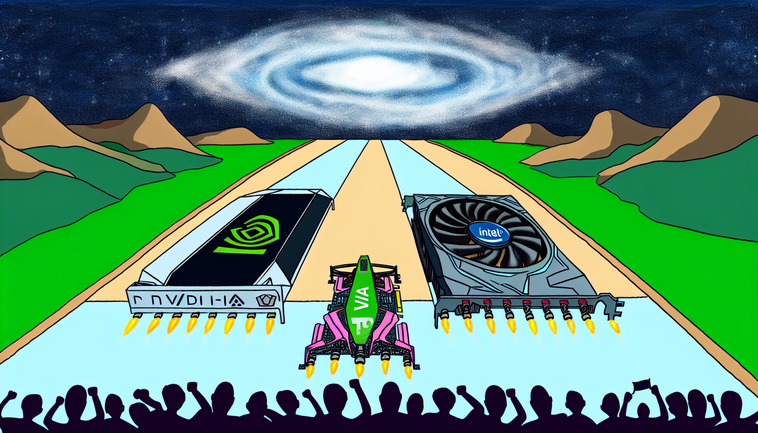
Every few years, the graphics card arena seems to replay the same storyline—Nvidia pushing the performance envelope, AMD racing to close the gap, and PC enthusiasts left choosing between the two. But as we peer toward 2026, one newcomer stands poised to rewrite that script: Intel’s much-anticipated ‘Nova’ architecture.
Intel’s foray into discrete graphics hasn’t exactly been a smooth ascent. The Arc series showed promise but wrestled with driver hiccups and modest market share. Yet behind the scenes, engineers have been refining key technologies—machine-learning cores, hardware ray-tracing units, and memory interfaces—to deliver a more balanced, stable product.
What makes the Nova GPU so intriguing is its hybrid focus on gaming and AI workloads. Early leaks hint at a streamlined Tensor engine capable of on-the-fly upscaling and real-time denoising, paired with dedicated ray-tracing hardware that rivals the latest big-name cards. Add in a revamped power-management scheme and you’ve got a design that could hit higher clock speeds without guzzling watts.
Beyond raw numbers, Intel is committing to open-source driver tools that promise broader compatibility across Linux and Windows, as well as faster rollout of game-ready optimizations. For developers, this could mean fewer compatibility headaches and a more transparent performance profile—an appealing proposition for studios and hobbyists alike.
From a market standpoint, Nova’s arrival could force AMD and Nvidia to rethink pricing tiers and feature sets. If Intel delivers on promises of performance per dollar and reliable software support, we may finally see a three-way price war that benefits gamers, content creators, and data-center customers.
On a personal level, I’m excited by the prospect of a genuine third option. Competition drives innovation, and Intel’s entry could spark breakthroughs in real-time graphics, AI acceleration, and even power efficiency. Imagine a future where everyone—casual players, e-sports athletes, and creative professionals—can pick the card that best suits their budget and workflow instead of resigning themselves to duopoly trade-offs.
In the end, Intel’s Nova GPU represents more than just another silicon revision; it’s a statement of intent. Should Intel succeed in delivering performance, stability, and affordability in equal measure, 2026 might just be the year the GPU landscape finally broadens beyond two names. And that, for anyone who values choice and progress, is worth getting excited about.