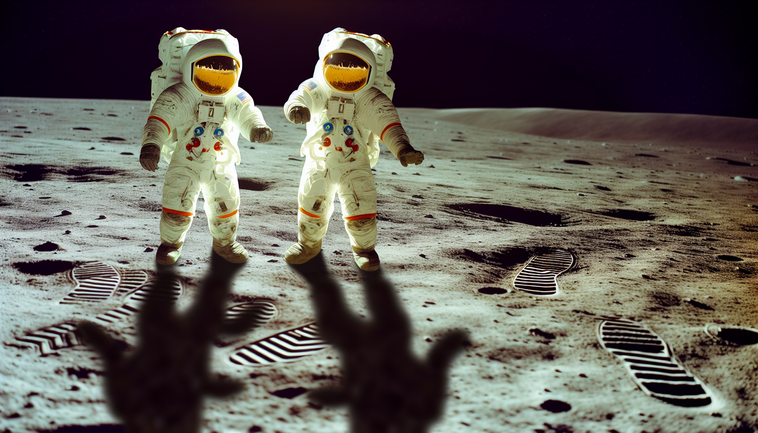
On a warm summer evening in 1969, two astronauts made history by venturing beyond Earth’s embrace and touching down on a silent celestial frontier. Their mission transcended politics and geography, offering humanity its first tangible connection to another world. That single moment ushered in a new era of exploration and ambition.
In the flickering glow of grainy television screens, viewers worldwide watched as bulky suits gingerly navigated a landscape covered in powdery gray regolith. The stark horizon, marred only by the curvature of the lunar surface, felt both alien and oddly familiar—proof that we could step outside our planet without losing our sense of wonder.
Centuries of stargazing culminated in this montage of triumph: launchpad roar, mid‐course adjustments, and limbs descending onto an ancient sea of rock. Those sequential frames stitched a narrative of perseverance, reminding us that preparation and daring can rewrite what we believe to be possible.
Beyond the technical marvels—guidance computers, propulsion systems, and life‐support gear—this achievement spoke to people’s dreams. It sparked an unwavering curiosity that rippled through science classes, inspired artists, and even eased global tensions by uniting onlookers under a shared sense of wonder and accomplishment.
Watching the lunar excursion unfold, I’m struck by how a pair of footprints could carry so much symbolism. They mark not only a conqueror’s passage but also a promise—to keep pushing our boundaries, to look upward and outward, and to remember that exploration often begins with a single bold step.
Today, as plans for returning to the moon and then reaching Mars advance in parallel with commercial space ventures, the Apollo 11 montage acts as both a high‐water mark and a starting line. It challenges engineers, dreamers, and young students to believe that the next giant leap might come from any corner of the globe.
Reflecting on that historic moonwalk reminds us that daring visions can unite humanity, spark profound innovation, and reshape our perspective on life itself. If one mission could alter the trajectory of our species, imagine what the next one will achieve.